MCU Flash File System

Most microcontrollers provide internal flash memory for storing program code and user data. However, this memory has a limited number of write cycles, which reduces the lifetime of individual memory cells when write operations occur frequently.

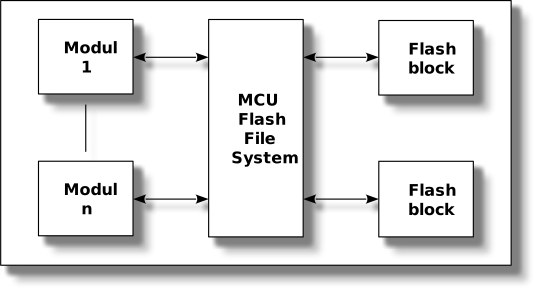
For the reliable storage of persistent data, we have developed a lightweight MCU Flash File System that distributes write operations across the flash memory, thereby minimizing the wear of individual memory areas. Serialized C structures are stored sequentially in the flash as so-called “files”, each identified by an ID and protected by a checksum.


New data records are written strictly in an append-only manner, while read operations automatically retrieve the latest valid and consistent entry for a given ID. Due to the underlying failsafe design, the data remains in a valid state at all times, even in the event of unexpected power loss or system interruptions.

In addition, the system simplifies the centralized storage of distributed module data, as only a single ID is required per data record.

Once a memory block is completely filled, a block switch is performed: a new block is erased and then written with the consolidated current data records. This approach enables robust, efficient, and wear-optimized data storage in resource-constrained embedded systems.

Our Services

  • Concept and development of an MCU Flash File System
  • Implementation of wear-leveling mechanisms for lifetime optimization
  • Integration into existing embedded systems

Technologies

Hardware

  • PIC24
  • STM32

Software / Methods

  • Flash File System – lightweight file system for MCU flash
  • Wear Leveling – distribution of write operations to reduce wear
  • Append-Only Logging – sequential data storage
  • Failsafe Design – consistent state in case of system interruptions
  • Checksum – data integrity protection
  • Data Consolidation – transfer of valid data records during block switching
  • Serialization – storage of C structures in flash

Programming Languages

  • C

Tools

Software development

  • KDevelop – C/C++ development environment

Debugging & Analysis

  • GDB – debugging and analysis of embedded software

Project Management & Version Control

  • Git – version control