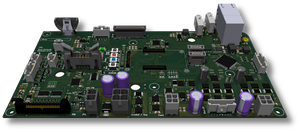
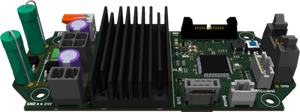
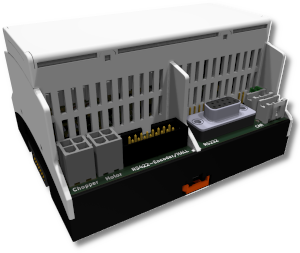
We developed a stepper motor controller with an external rotary sensor and PLC expansion.
The core components of the controller are an STM32 microcontroller, which functions as the communication controller, and a TMC2590, which handles the motor commutation.
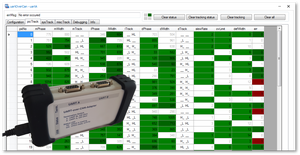
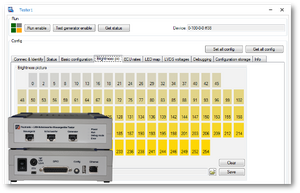
The TPS92662 is a powerful high-brightness LED matrix manager for LED headlights. It enables efficient control and monitoring of LED arrays in modern vehicle lighting systems.
For easy use and analysis, we have developed a dedicated TPS92662 monitor. It allows simultaneous logging and configuration of UART channels. The monitor consists of a hardware adapter and a CANoe integration, significantly simplifying error diagnostics, monitoring, and control of the LED matrix.
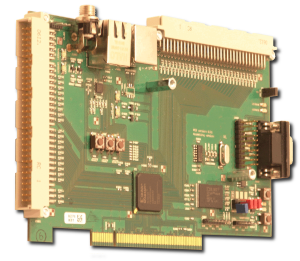
We developed a PCI card designed for the evaluation of FPGA-based signal processing algorithms, supporting various analog-to-digital converters as well as copper-based data transmission methods, such as Ethernet and RS422, over distances of up to 200 m.
It supports various analog-to-digital converters as well as copper-based data transmission methods, such as Ethernet and RS422, over distances of up to 200 m.
For a sliding door system, we developed a motor controller that uses the TMC4671 motor controller and is managed by a STM32 microcontroller.
It combines FOC-based control, digital inputs and outputs, and a battery-backed RTC with a cross-platform Qt PC application for easy configuration and operation.
For a BLDC motor, we developed a motor controller based on a Xilinx Zynq 7000 SoC. It combines sinus commutation, a positioning system, and FPGA-based FOC control with an embedded Linux application for configuration and monitoring.
For the testing and validation of LED headlight control units, we have developed several modular control unit testers that capture and analyze data traffic between control units and headlights, and enable targeted fault injection.
A Qt-based application for visualization, along with integration into CANoe, enables convenient operation and comprehensive analysis.
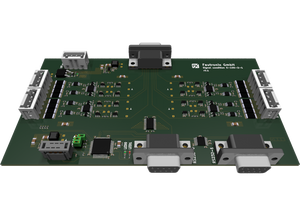
For an automotive HIL system, we have developed a multichannel PWM signal conditioning that converts current-based PWM signals into measurable voltage signals up to 80 V.
Flexible parameterization via CANoe, automatic calibration, and cascadable UART communication enable precise adaptation and easy integration into complex test environments.