
PWM signal conditioning for HIL
For an automotive HIL system, we have developed a multichannel PWM signal conditioning with a CANoe-based configuration frontend.
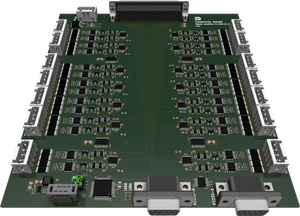
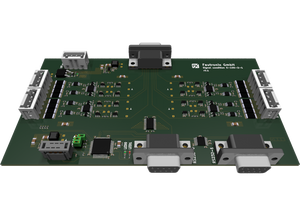
The signal conditioning converts a current-based PWM signal in the milliampere range with an offset voltage and variable frequency into a ground-referenced voltage signal of up to 80 V, which can be reliably measured by the HIL system.
The thresholds for converting current signals into voltage signals are configurable and are set during system startup by an STM32 microcontroller. An ADC in each PWM channel enables current measurement for automatic parameterization, controlled via the CANoe frontend.
Communication between the STM32 and the HIL system is handled via UART. Multiple signal conditioning units can be cascaded; the UART high-level protocol is address-based, with addresses configured via hardware jumpers.
Our Services
- Concept and development of the electronics
- Assembly of the electronics
- Development of the STM32 software
- Development of CANoe widgets and CAPL software
Technologies
Hardware
- STM32 – microcontroller for control and configuration
- DAC – digital-to-analog converter
- ADC – analog-to-digital converter
- I2C bus switch – switching of I2C connections
- Operational amplifier (OpAmp)
- Instrumentation amplifier
- Current shunt monitor – current measurement via shunt resistor
Programming Languages
- C
- C#
- CAPL
Methods
- Current PWM – current-based PWM signal
- Voltage PWM – voltage-based PWM signal
Interfaces
- I2C
- UART
Tools
Regulatory Requirements
The following regulations were taken into account:
- Machinery Directive / Machinery Regulation
- Low Voltage Directive
- RoHS