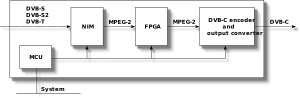
TV headends are used to feed both analog and digital television into cable networks. Their primary function is to convert television signals from any source (satellite, terrestrial broadcasts, or radio) into cable-specific formats.
For such headends, we have developed FPGA designs and implemented their control via microcontrollers.
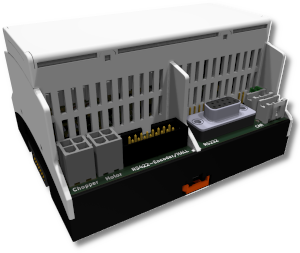
We developed a stepper motor controller with an external rotary sensor and PLC expansion.
The core components of the controller are an STM32 microcontroller, which functions as the communication controller, and a TMC2590, which handles the motor commutation.
For a sliding door system, we developed a motor controller that uses the TMC4671 motor controller and is managed by a STM32 microcontroller.
It combines FOC-based control, digital inputs and outputs, and a battery-backed RTC with a cross-platform Qt PC application for easy configuration and operation.
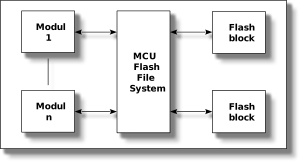
For the failsafe storage of persistent data in microcontrollers, we have developed a lightweight MCU Flash File System that increases the lifetime of flash memory through optimized write operations.
Through append-only logging, checksum validation, and wear leveling, it enables robust and efficient data management in embedded systems.
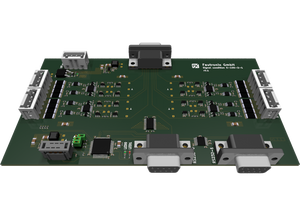
For an automotive HIL system, we have developed a multichannel PWM signal conditioning that converts current-based PWM signals into measurable voltage signals up to 80 V.
Flexible parameterization via CANoe, automatic calibration, and cascadable UART communication enable precise adaptation and easy integration into complex test environments.